
Exciting new series on “Voice, Body and Movement for Lawyers – How to connect with the jury and find Justice Through Dramatic Technique!”
Click here to find out more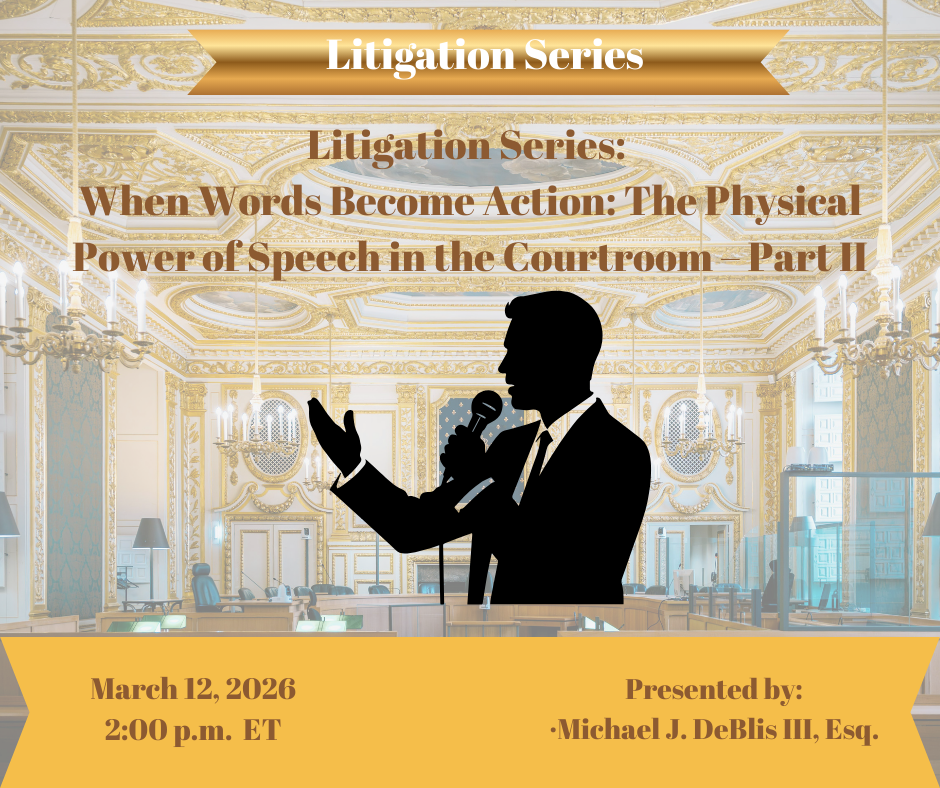
Part II builds on the foundation established in Part I by examining how classical rhetorical styles operate as strategic advocacy tools in modern trial practice. Drawing on historically recognized principles of rhetoric, the program explains how variations in clarity, moral weight, emotional force, credibility, and pacing influence how jurors interpret evidence and evaluate advocates. These stylistic elements are presented not as literary theory, but as practical mechanisms for guiding juror reasoning and decision-making.
Participants will explore how skilled trial lawyers deliberately shift rhetorical style at different stages of litigation—using clarity to orient jurors, moral force to emphasize wrongdoing, sincerity to address weaknesses, and controlled intensity during cross-examination or closing argument. The session provides concrete courtroom applications showing how stylistic alignment strengthens credibility, reinforces case themes, and avoids juror resistance. By integrating classical style with modern trial advocacy, attorneys gain tools for delivering arguments that are structured, persuasive, and firmly grounded in legal practice.
Explore the transformative potential of generative AI in modern litigation. “Generative AI for...
Part 2 - This program will continue the discussion from Part 1 focusing specifically on cross?examin...
This program provides a comprehensive and practice-oriented framework for integrating criminal mitig...
In this second segment we will continue with our journey into the multiple elements of high-level ne...
Effective data privacy and artificial intelligence governance programs do not happen by accident. Th...
Many solo and small law firms assume AI governance is something only large firms need. It is not. AI...
This program examines listening as an active, strategic trial advocacy skill rather than a passive c...
The CLE will cover the Ins and Outs of Internal Corporate Investigations, including: Back...
“Everyone tells me I’m doing a great job. My clients, my colleagues, my family. Wh...
During this presentation, you will learn about the regulations and caselaw controlling claims and re...